
Will OQEP Reward Investors in 2026?
Investment Summary
OQ Exploration and Production SAOG, or OQEP, remains one of the strongest cash-generating companies listed on the Muscat Stock Exchange.The company faced lower oil prices during 2025 and early 2026. However, higher sales volumes, low production costs and disciplined capital management protected its cash flow.The key investor question has now changed. Investors no longer need to ask whether OQEP can survive weaker oil prices. They must ask whether the company can finance rising investment while maintaining its generous dividends.At around 440 baisa per share, OQEP appears fairly valued rather than deeply undervalued. The stock offers an attractive dividend yield and a strong balance sheet. However, its planned 2026 capital expenditure could limit future performance-linked dividends.
OQEP’s Investment Case
OQEP is Oman’s largest oil and gas exploration and production company.
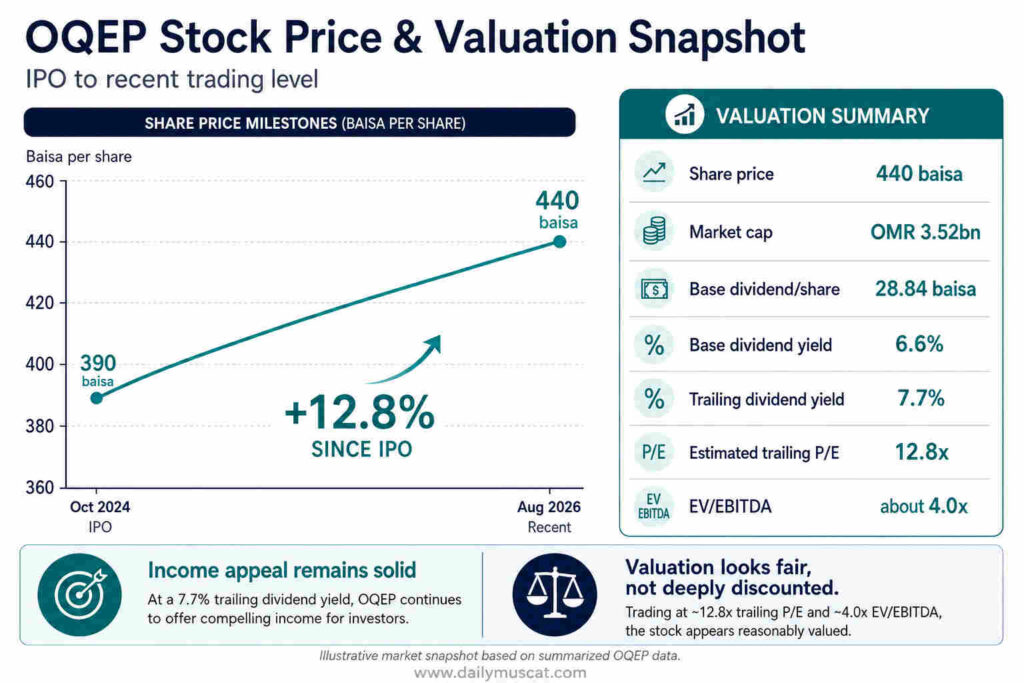
It is listed on the Muscat Stock Exchange under the ticker OQEP, trading at OMR 0.440(1.14 USD) per share.
The company maintains joint ventures with 13 leading international energy companies.
OQEP supports Oman’s energy security, economic growth, and Vision 2040 objectives.
Its quality assets, advanced technology, and cost efficiencies strengthen operational performance.
The company prioritizes safety, environmental protection, local communities, and In-Country Value.
OQEP aims to reduce emissions and achieve net-zero operations by 2050.
OQEP is Oman’s largest listed pure-play oil and gas exploration and production company. Its portfolio covers 14 operated and non-operated assets.
The company works with major international energy groups, including BP, Shell, TotalEnergies and Occidental. Its portfolio combines oil exposure with long-term gas contracts, which provide a degree of revenue stability.
OQEP produced approximately 224,000 barrels of oil equivalent per day during 2025. Oil and condensate represented about 54% of production, while gas contributed approximately 46%.
Management also kept operating costs below US$10 per barrel of oil equivalent. This low-cost structure helps OQEP generate cash during weaker oil-price periods.
FY2025 Results: Lower Earnings but Better Cash Flow
OQEP’s 2025 results showed a clear difference between accounting earnings and underlying cash generation.
| Financial indicator | FY2024 | FY2025 | Change |
|---|---|---|---|
| Revenue | OMR1.243bn | OMR1.159bn | -6.7% |
| EBITDA | OMR1.011bn | OMR941.1mn | -6.9% |
| Net profit | OMR326.6mn | OMR278.0mn | -14.9% |
| Adjusted operating cash flow | OMR502.9mn | OMR540.5mn | +7.5% |
| Capital expenditure | OMR245.6mn | OMR257.5mn | +4.8% |
| Estimated free cash flow | OMR257.3mn | OMR283.0mn | +10.0% |
| Net debt | OMR222.7mn | OMR222.8mn | Broadly flat |
| Return on capital employed | 49.9% | 50.6% | Improved |
Net profit fell almost 15%, but this decline does not tell the complete story.
OQEP’s average realised oil price decreased from US$80.80 per barrel to US$70.70, representing a 12.5% decline. The company partly offset this pressure by increasing oil and condensate sales from 20.3 million barrels to 21.7 million barrels.
The company also lost the contribution from Abraj Energy Services following its transfer to OQ before OQEP’s public listing. Higher financing costs created further pressure on reported earnings.
Despite these challenges, adjusted operating cash flow increased by 7.5%. This suggests that OQEP’s operating performance remained stronger than the decline in net profit implied.
Q1 2026: Resilience Despite Lower Oil Prices

OQEP maintained relatively stable results during the first quarter of 2026.
| Financial indicator | Q1 2025 | Q1 2026 | Change |
| Reported revenue | OMR294.7mn | OMR296.4mn | +0.6% |
| Revenue excluding EPSA tax revenue | OMR205.5mn | OMR218.5mn | Approximately +6% |
| EBITDA | OMR240.2mn | OMR226.7mn | -5.6% |
| Net profit | OMR74.9mn | OMR72.0mn | -3.9% |
| Capital expenditure | OMR57.4mn | OMR62.6mn | +8.9% |
| Free cash flow | OMR19.8mn | OMR70.7mn | +256% |
| Net debt | OMR264.2mn | OMR216.3mn | -18% |
| Production | Approximately 221 kboepd | Approximately 224 kboepd | More than +1% |
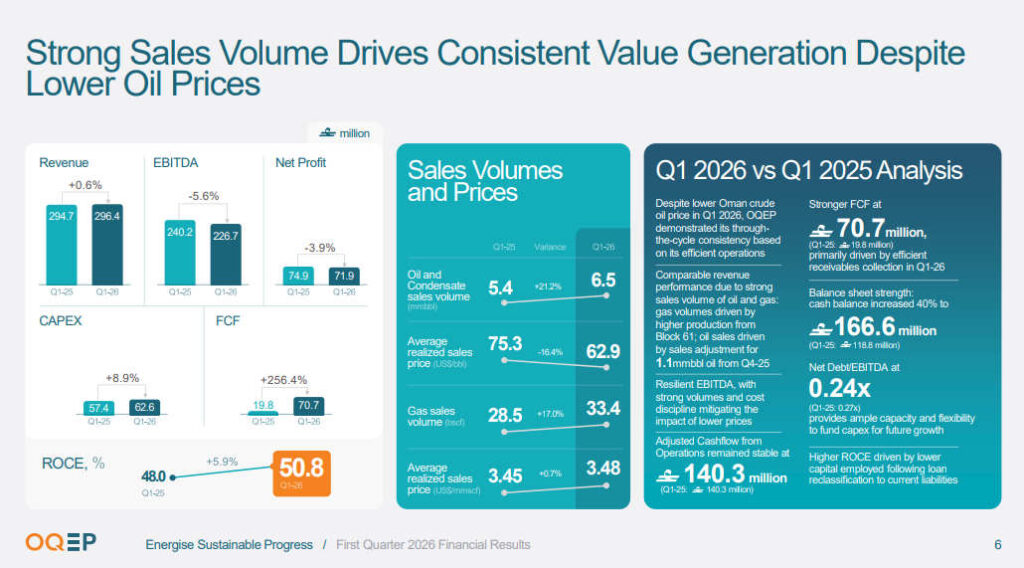
The company achieved these results despite an approximately 16% decline in its realised oil price.
Higher gas sales and the sale of oil volumes carried forward from late 2025 supported revenue. OQEP had recorded around 1.1 million barrels as inventory at the end of 2025 because those barrels had not yet been lifted or sold.
EBITDA declined, but net profit fell by only 3.9%. Free cash flow improved sharply because of stronger collections and the timing of oil sales.
This was a solid quarter, although part of the cash-flow improvement resulted from timing rather than permanent structural growth.
Balance Sheet Remains a Major Strength
OQEP ended Q1 2026 with approximately OMR216.3 million of net debt and OMR167 million of cash.
Its net-debt-to-EBITDA ratio remained close to 0.24 times, leaving the company with considerable borrowing capacity.
Management has set a maximum leverage target of around one times net debt to EBITDA under the current oil-price environment.
The company could therefore increase debt to fund attractive projects or acquisitions. However, management must maintain strict investment discipline. Low leverage creates value only when new investments generate strong returns.
Dividends Remain Attractive
OQEP distributed approximately OMR275 million during 2025, including base and performance-linked dividends.
The company’s 2026 policy provides for an annual base dividend of approximately OMR230.7 million, paid quarterly. Performance-linked dividends may provide additional returns when free cash flow allows.
With eight billion shares outstanding, the annual base dividend equals approximately:
28.84 baisa per share
At a share price of 440 baisa, this represents a base dividend yield of approximately:
6.6%
OQEP’s trailing 12-month dividend is around 34 baisa per share, producing a historical yield of approximately 7.7% at the same share price.
However, total 2025 dividends consumed almost all estimated free cash flow.
OQEP generated approximately OMR283 million of free cash flow and distributed OMR275 million. That represents a cash payout ratio of roughly 97%.
The base dividend appears sustainable. Performance-linked distributions will remain more sensitive to oil prices, production timing and capital expenditure.
The Main 2026 Risks:
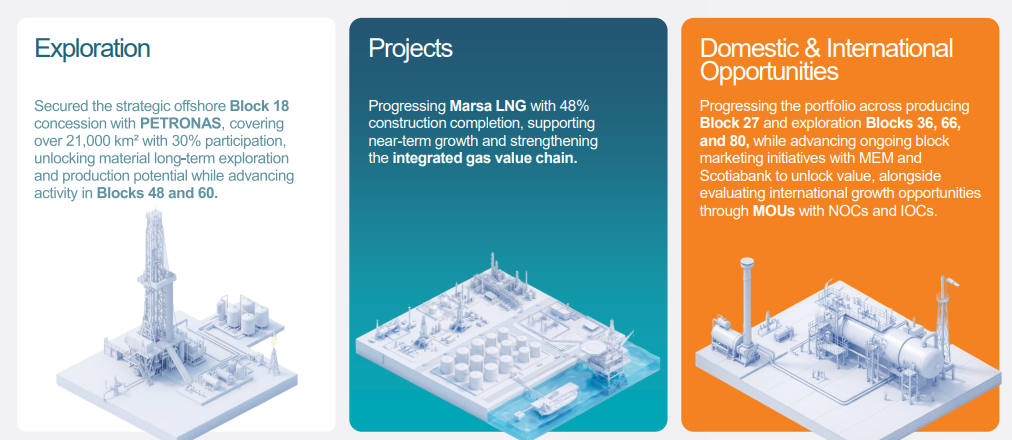
Management expects 2026 capital expenditure of approximately US$800 million to US$900 million, equal to roughly OMR308 million to OMR346 million.
The company spent only OMR62.6 million during Q1. Therefore, most planned expenditure remains scheduled for the final three quarters.
This creates three risks.
First, higher investment could reduce free cash flow even when operating cash flow remains stable.
Second, OQEP may need additional borrowing if oil prices weaken or projects exceed their budgets.
Third, performance-linked dividends could decline because the company calculates them after considering investment requirements.
The spending also creates an opportunity. Successful investment could support OQEP’s goal of increasing production toward 300,000 barrels of oil equivalent per day by 2030.
Investors must therefore monitor returns generated from the new expenditure, not simply the total amount invested.
Principal Risks
The largest risk remains lower oil prices. OQEP’s gas contracts provide stability, but oil and condensate still make a major contribution to profitability.
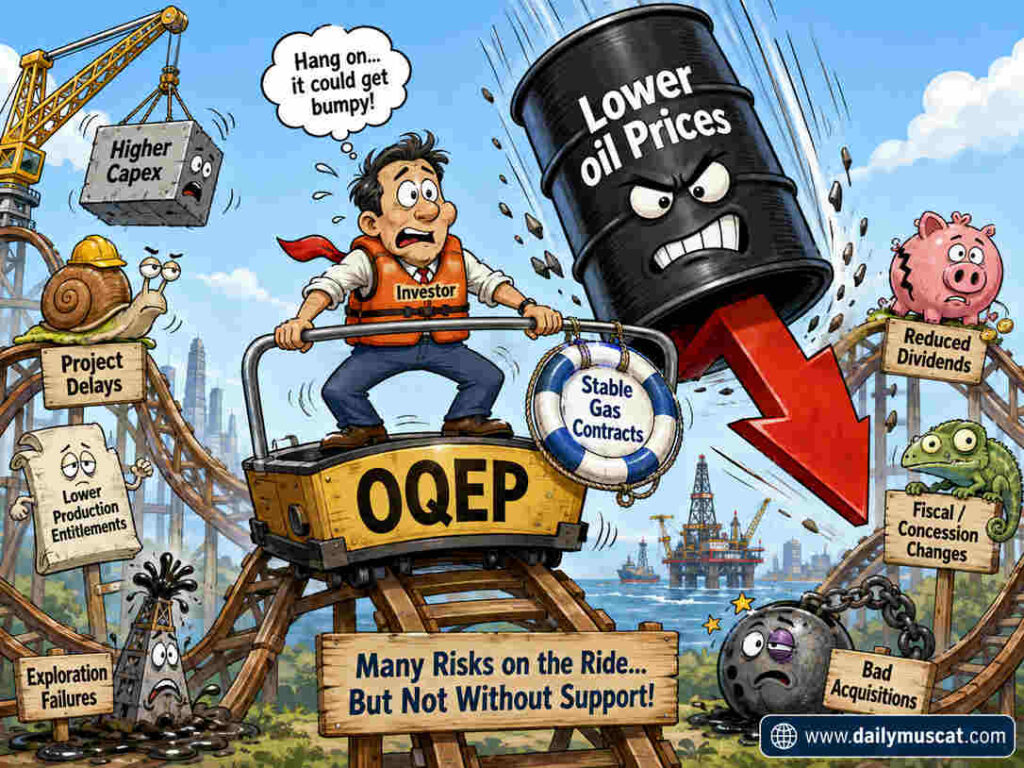
Other risks include:
- Higher-than-planned capital expenditure
- Project delays
- Lower production entitlements
- Exploration failures
- Reduced performance-linked dividends
- Changes in concession or fiscal terms
- Acquisitions that fail to generate adequate returns
Investment View
OQEP combines low production costs, strong cash generation, manageable debt and an attractive dividend profile. Its 2025 results also showed resilience, as operating cash flow improved despite weaker realised oil prices.

However, future performance will remain closely linked to oil prices, production levels and the success of planned capital expenditure. Higher investment may support long-term growth, but it could also reduce free cash flow and limit additional dividends in the near term.
At the current market price, OQEP appears reasonably valued based on its earnings, balance sheet and dividend potential. The company remains an important option for investors seeking exposure to Oman’s energy sector, although its results should be assessed alongside commodity-price risks and future investment requirements.
Overall, OQEP presents a financially solid profile, supported by efficient operations and low leverage. Its longer-term performance will depend on how effectively management converts new investment into higher production, reserves and sustainable shareholder returns.
Disclaimer : This article provides general financial research and does not constitute personalized investment advice.