
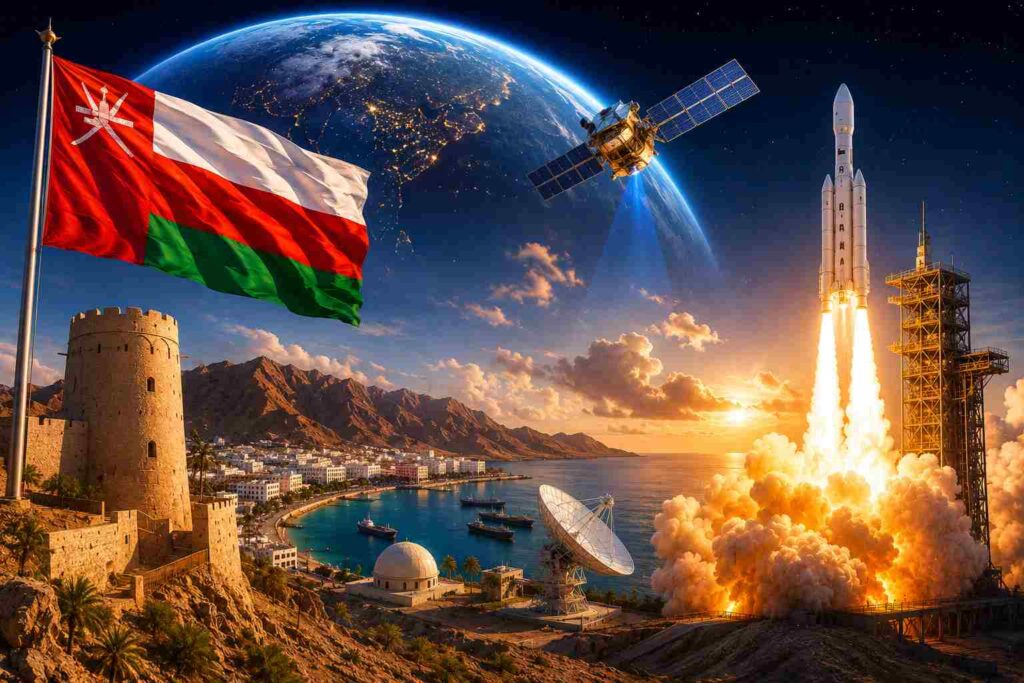
Oman Reaches for the Stars
Oman is entering an exciting era of science, innovation and advanced technology.
Famous for its maritime history, strategic location and natural beauty, the Sultanate is now looking towards outer space.
The Oman Space Program is developing satellites, launch infrastructure, research projects and commercial opportunities. It also supports the country’s transition towards a knowledge-based economy.
Oman is not pursuing space technology simply for international recognition. Its strategy focuses on practical solutions that can support communications, environmental protection, education, logistics and economic growth.
Through careful investment and international cooperation, Oman aims to become an important regional gateway for space services and applications.
A National Vision for Space
Oman’s National Space Program covers the period from 2023 to 2033.
Led by the Ministry of Transport, Communications and Information Technology, the program aims to strengthen economic diversification, national capabilities, sustainability and international cooperation.
Its long-term ambition is to establish Oman as a regional centre for space applications and services. The strategy includes satellite development, commercial launching, research, education and support for technology startups.
The program is being developed gradually. This allows Oman to strengthen its regulations, infrastructure and technical workforce before moving towards larger and more complex missions.
Rather than immediately competing in expensive deep-space projects, Oman is concentrating on technologies that can deliver clear benefits on Earth.
OL-1 Places Oman on the Space Map
A major milestone came with the launch of OL-1 in November 2024.
Developed through the Omani company Oman Lens, OL-1 is an Earth-observation satellite using remote-sensing and artificial-intelligence technologies.
It can capture and analyse images of landscapes, infrastructure and natural resources. Its data may support urban planning, agriculture, environmental monitoring and emergency response.
The project also represents an important step towards creating locally developed space capabilities within Oman.
Small satellites such as OL-1 can provide valuable information without requiring the enormous budgets associated with major international missions.
They can also create opportunities for local engineers, software developers, researchers and data-analysis companies.
OmanSat-1 Strengthens Connectivity
Oman is also advancing OmanSat-1, its planned national communications satellite.
The project is designed to provide high-capacity communication services across Oman, its economic waters and surrounding regional markets.
Potential applications include broadband connectivity, government networks, banking services, maritime communications and support for aviation and energy operations.
A national communications satellite could provide Oman with greater control over its digital infrastructure while reducing dependence on external systems.
The OmanSat-1 project also supports the wider objective of increasing the space sector’s contribution to Oman’s economy.
Duqm Becomes a Gateway to Space
Oman’s geographical position gives it a valuable advantage.
Etlaq Spaceport is being developed in Duqm as a commercial launching facility for scientific, experimental and future orbital missions.
Located at approximately 18 degrees latitude, the site offers access to several useful orbital paths. Its coastal position can also provide safer flight directions away from heavily populated areas.
Duqm’s port, airport and special economic zone can support the movement, preparation and storage of rockets, satellites and specialised equipment.
Etlaq could eventually attract international launch companies seeking access to a strategically positioned spaceport in the Middle East.
The project could generate opportunities in engineering, logistics, manufacturing, tourism and advanced technical services.
Duqm-1 Opens a Historic Chapter
Duqm-1 became Oman’s first suborbital mission.
The experimental flight tested launch procedures, operational coordination and supporting ground systems.
Although a suborbital rocket does not place a satellite into permanent orbit, it provides valuable experience. Engineers can test technologies and identify improvements before attempting more advanced missions.
Etlaq describes Duqm-1 as a foundation for future orbital programs and Oman’s wider launch ambitions.
Each experimental spaceship, rocket or space ship project can help Oman develop the technical experience required for more ambitious operations.
Space Technology Supporting Daily Life
The Oman Space Program could influence many areas of everyday life.
Satellite data can help authorities monitor coastal erosion, desert expansion, water resources and changing agricultural conditions.
It can also support the development of roads, ports, industrial zones and growing cities.
During floods, storms or other emergencies, Earth-observation information can help decision-makers understand affected areas and coordinate faster responses.
Telecommunications satellites can improve connectivity in remote communities while supporting ships, aircraft and offshore industries.
These practical applications show that space exploration is not limited to astronauts and distant planets. It can also solve important challenges on Earth.
Developing Omani Space Startups
A successful space industry cannot depend entirely on government projects.
Oman is therefore encouraging local companies and entrepreneurs to develop commercial space products.
Potential business opportunities include satellite-image analysis, artificial intelligence, geographic information systems and cybersecurity.
Omani startups may also provide services involving weather monitoring, digital mapping, drone technology and communications.
The National Space Program already includes initiatives such as space accelerators, satellite-data platforms and CubeSat development.
These projects can help convert scientific knowledge into companies, skilled employment and long-term investment.
Inspiring Oman’s Younger Generation
Education will play a central role in Oman’s space ambitions.
Future projects will require scientists, engineers, programmers, researchers and highly trained technicians.
Oman has worked on introducing space and astronomy concepts into school education. The initiative involves several national organisations and seeks to build early interest in science and technology.
A future space camp could give students practical experience in astronomy, robotics and satellite design.
Interactive space games could make difficult scientific ideas easier for children to understand.
A specialised space museum could display rocket models, satellite technology, astronomical discoveries and Oman’s progress in the sector.
Students could learn how a space suit protects astronauts or how a rocket carries a spacecraft beyond Earth’s atmosphere.
Such educational experiences could inspire young Omanis to pursue careers in science, technology, engineering and mathematics.
Oman and the Global Space Conversation
Oman’s emerging program forms part of a much larger global space industry.
Millions of people follow a SpaceX launch, search for SpaceX stock information or watch live space coverage of major rocket missions.
Search terms such as Space X, Space X launch and SpaceX rocket launch reflect the growing public interest in commercial launching.
SpaceX operates Falcon missions and develops the Starship system for journeys to Earth orbit and destinations beyond it. Its launches support commercial satellites, human spaceflight and space station resupply operations.
Major launches also take place from locations such as Cape Canaveral Space Force Station, where the United States Space Force supports range safety and launch operations.
Oman is not attempting to copy these systems immediately. However, international experience can provide valuable lessons as Etlaq develops its own commercial model.
Learning From Major Space Missions
Global space achievements can inspire Oman’s scientists and students.
NASA’s Space Launch System represents one of the major rocket systems associated with lunar exploration.
The International Space Station demonstrates how nations can cooperate in scientific research while living and working in orbit.
NASA’s Johnson Space Center supports human-spaceflight operations and leads work connected with the International Space Station, Orion and future exploration programs.
Historic programs involving the space shuttle helped advance reusable spacecraft operations and supported important scientific missions.
Powerful observatories such as the Hubble Space Telescope have expanded humanity’s understanding of distant galaxies.
The James Webb Space Telescope continues this scientific journey by studying different stages in the history of the universe.
For students interested in astronomy, the James Webb Space Telescope demonstrates how engineering, international cooperation and scientific ambition can transform our understanding of space.
These global achievements can encourage Oman to develop its own research, educational and commercial strengths.
Environmental Protection From Orbit
Oman’s diverse natural environment makes satellite monitoring especially valuable.
The country has a long coastline, extensive deserts, mountain ranges and sensitive marine ecosystems.
Satellite images can help identify environmental changes over time.
They may support the monitoring of coastal areas, vegetation, fisheries and freshwater resources.
Farmers could use satellite information to understand crop health and improve irrigation decisions.
Government agencies could also use Earth-observation data for city planning and infrastructure development.
By connecting space technology with sustainability, Oman can make its program directly relevant to national priorities.
International Cooperation Expands
International partnerships are essential because space projects require specialised knowledge, advanced equipment and significant investment.
Oman strengthened its position in the international community by signing the Artemis Accords on January 26, 2026.
It became the 61st signatory at the time of joining.
The accords promote peaceful, transparent and responsible civil-space activities. They also encourage cooperation and the sharing of scientific information.
Such partnerships can help Oman gain experience, attract international investment and develop globally recognised technical standards.
They can also create research and training opportunities for Omani universities and technology companies.
Challenges on the Journey Ahead
Building a successful space industry requires patience.
Satellites, launch facilities and research centres involve high costs and complex technical requirements.
Safety must remain a priority, particularly when rockets are launched near national airspace or shipping routes.
Oman will also need strong regulations, specialised laboratories and a steady supply of qualified professionals.
Commercial projects must eventually generate economic value rather than depend permanently on public funding.
Private companies, universities and international partners will therefore be essential to the program’s long-term success.
A New Future Above Oman
Oman’s journey towards space is only beginning, but its direction is clear.
The Sultanate is building more than a single satellite or launchpad. It is developing a connected ecosystem involving satellites, commercial launches, education, research and private investment.
OL-1 has strengthened Oman’s Earth-observation capabilities.
OmanSat-1 could transform communications.
Etlaq Spaceport could establish Duqm as a regional launching destination.
Educational programs could prepare a new generation of Omani scientists and engineers.
Through practical planning and responsible cooperation, the Oman Space Program could become an important part of Oman Vision 2040.
Its success will not be measured only by how far a rocket travels into space.
The greater achievement will be using space technology to protect the environment, strengthen the economy and create opportunities for future generations.