
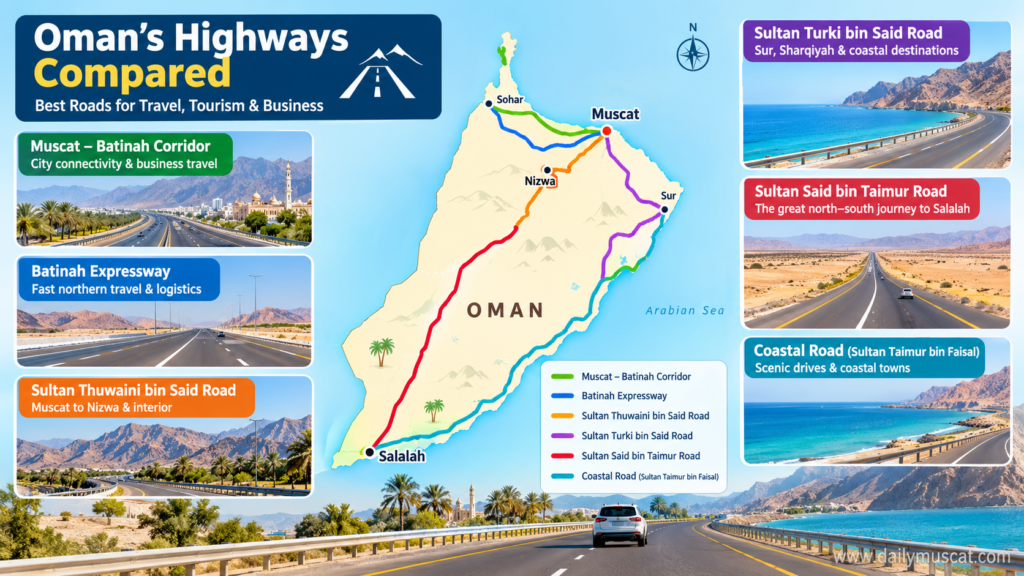
Oman Highways: Best Roads Compared
Oman is a country where every journey can become an adventure. From the modern, bustling roads of Muscat to the dramatic mountain routes, scenic coastal highways and endless desert roads stretching toward Salalah, the Sultanate offers an impressive road network connecting cities, communities and major economic centres.
For residents, tourists, businesses and road-trip lovers, choosing the right highway can make a journey faster, safer and far more enjoyable. Some roads are built for quick regional connections and heavy traffic, while others open the door to spectacular landscapes, coastal views, tourism destinations and long-distance travel.
With Oman continuing to invest in modern transport infrastructure, its highways are becoming increasingly important for tourism, trade, logistics and economic development.
So, which highways stand out the most? Here is a practical comparison of some of Oman’s major roads and highway corridors, highlighting what each route offers and where it can take you.
1. Sultan Qaboos Road / Muscat–Batinah Corridor

🚗 A Key Gateway to Northern Oman
The Sultan Qaboos Road and Muscat–Batinah corridor form one of the most important road connections in northern Oman. Linking the capital with rapidly developing communities and commercial centres across Al Batinah, the route plays a vital role in everyday travel, business and regional transportation.
Stretching for roughly 300 kilometres from Qurum in Muscat toward Khatmat Malaha, this major corridor helps connect people, businesses and communities across northern Oman.
Whether you are heading out of Muscat for business, travelling toward Sohar and other northern destinations, or continuing toward the UAE border, this route provides an important link between the capital and the country’s northern gateway.
⭐ Why Drivers Choose This Route
- Daily commuting: An important route for people travelling around Muscat and northern Oman.
- Business & trade: Supports movement between commercial and industrial centres.
- Northern connectivity: Provides a major connection between Muscat and Al Batinah.
- Regional travel: Useful for journeys toward northern Oman and the UAE.
- Easy accessibility: Numerous communities and commercial areas can be reached from the corridor.
🏆 Main Advantage
Excellent connectivity and accessibility.
The biggest strength of this corridor is its ability to connect Muscat with northern Oman efficiently, making it an important part of the Sultanate’s transportation network.
⚠️ What Should Drivers Expect?
The busiest sections are generally around Muscat and other populated urban areas, where traffic can be noticeably heavier than on Oman’s more remote highways. Drivers should therefore allow extra time during peak commuting periods.
🌟 DailyMuscat Verdict
Best suited for: Commuters, business travellers and drivers connecting Muscat with northern Oman.
Overall appeal: ⭐⭐⭐⭐☆
2. Batinah Expressway

For motorists travelling north from the capital, the Batinah Expressway stands out as one of Oman’s most important modern road networks. Designed to make long-distance travel faster and more efficient, the expressway provides a vital link between the Muscat area, North Al Batinah and destinations extending toward Khatmat Malaha.
Earlier official descriptions placed the expressway at approximately 270 kilometres. It is important to distinguish this from the wider Sultan Taimur bin Faisal coastal corridor, which the ministry separately identifies at around 244 kilometres.
More than simply a highway, the Batinah Expressway serves as a major transportation artery for northern Oman. It helps connect residential communities with ports, industrial centres, logistics hubs and economic zones, supporting both everyday travel and commercial activity.
🚗 Best For
- Long-distance journeys toward northern Oman
- Commercial and logistics transportation
- Travelling to Sohar, Shinas and surrounding areas
- Accessing industrial and economic zones
- Faster regional movement between communities
⚡ Main Advantage
Fast and efficient regional connectivity.
The expressway is particularly valuable for drivers who want to cover long distances with fewer delays and convenient connections to major northern destinations.
🌊 A Different Travel Experience
While the Batinah Expressway prioritizes speed, efficiency and connectivity, it may not be the first choice for travellers whose main goal is to enjoy a relaxed coastal drive. Those looking for sea views, traditional towns and a more scenic journey may prefer routes closer to Oman’s coastline.
🛣️ Why It Matters
The Batinah Expressway is an important part of Oman’s expanding transportation infrastructure. By linking major communities, commercial centres and logistics facilities, it supports the movement of people, goods and business activity across the northern region.
In simple terms: if speed and connectivity are your priorities, the Batinah Expressway is one of the strongest choices for travelling north from Muscat.
3. Sultan Thuwaini bin Said Road

The Rusayl–Bidbid corridor is a crucial transportation link connecting the busy Muscat metropolitan area with Oman’s interior regions. For thousands of motorists travelling beyond the capital, this route serves as an important gateway toward Nizwa, Al Dakhiliyah and central Oman.
According to the Ministry of Transport, Communications and Information Technology, the 27-kilometre Rusayl–Bidbid expansion has been completed. The project includes additional traffic lanes, upgraded bridges, flyovers and pedestrian bridges, strengthening the road’s capacity and improving movement along this important corridor.
Beyond making journeys smoother, the upgraded route supports the daily movement of residents, businesses and commercial vehicles between Muscat and the interior governorates.
🚗 Best For
- Muscat–Nizwa journeys
- Daily regional commuting
- Travel toward Al Dakhiliyah and central Oman
- Commercial and business transportation
- Connecting Muscat with interior communities
⚡ Main Advantage
A vital gateway from Muscat to Oman’s interior.
The corridor offers motorists an important and efficient connection away from the capital, helping improve regional mobility and supporting economic activity between Muscat and the interior.
🛣️ Why It Matters
The Rusayl–Bidbid route is more than just a road. It forms part of Oman’s wider effort to strengthen its modern transport infrastructure, improve road capacity and create smoother connections between the country’s major population and economic centres.
For drivers heading from Muscat toward Nizwa and the interior, the Rusayl–Bidbid corridor remains one of the most important routes on the journey.
4. Sultan Turki bin Said Road

For motorists leaving Muscat and heading toward Oman’s interior, the Rusayl–Bidbid corridor is one of the country’s key transportation routes. It creates an important connection between the capital’s growing metropolitan area and destinations such as Nizwa, Al Dakhiliyah and central Oman.
The 27-kilometre Rusayl–Bidbid expansion, completed under Oman’s transport development programme, has significantly strengthened the corridor. The project features additional lanes, improved bridges, flyovers and pedestrian bridges, helping increase road capacity and making movement more efficient for motorists.
The upgraded route is particularly valuable for the daily flow of residents, commuters, businesses and commercial vehicles travelling between Muscat and the interior governorates.
🚗 Best For
- Muscat–Nizwa travel
- Daily commuting between regions
- Journeys toward Al Dakhiliyah and central Oman
- Commercial and business transportation
- Connecting interior communities with Muscat
⚡ Biggest Advantage
A faster and stronger connection to Oman’s interior.
For drivers moving beyond the capital, the corridor provides a dependable route toward some of Oman’s most important inland destinations while supporting smoother regional transportation.
🛣️ Why This Corridor Matters
The Rusayl–Bidbid route is much more than a stretch of asphalt. It represents an important part of Oman’s continuing investment in modern road infrastructure and regional connectivity.
By expanding capacity and improving major road structures, the project helps accommodate growing traffic while strengthening the connection between Muscat and Oman’s interior economic centres.
🏜️ The Gateway Beyond Muscat
Whether the destination is Nizwa, Al Dakhiliyah or another inland community, the Rusayl–Bidbid corridor plays a central role in taking travellers from the capital toward the heart of Oman.
For speed, connectivity and access to the interior, Rusayl–Bidbid is a road that keeps Oman moving.r.
5. Sultan Said bin Taimur Road — Adam to Thumrait

If there is one highway that captures the scale of Oman’s north–south road network, it is the Sultan Said bin Taimur Road. Stretching from the Nizwa–Adam area toward Salalah, this major national corridor connects the northern and central parts of the Sultanate with the Dhofar region.
The Ministry of Transport, Communications and Information Technology currently identifies the Nizwa–Salalah corridor at approximately 857 kilometres, making it one of Oman’s most important long-distance road connections.
A major part of this route is being strengthened through the Adam–Haima–Thumrait dualisation programme. The government is continuing work on three sections between Haima and Thumrait, with the projects together covering around 400 kilometres.
🚗 Best For
- Northern Oman–Salalah road trips
- Long-distance tourism journeys
- Freight and commercial transportation
- Connecting central Oman with Dhofar
- Khareef-season travel to Salalah
⚡ Biggest Advantage
Oman’s major north–south road connection.
The route provides an essential transportation backbone across vast areas of the country, supporting tourism, trade, freight movement and connections between distant communities.
🏜️ A Journey Across Oman
Unlike urban highways around Muscat, this is a road-trip route where the landscape itself becomes part of the experience. Travellers can journey across Oman’s vast interior, passing through remote desert landscapes and sparsely populated areas before eventually reaching the greener surroundings of Dhofar.
During the Khareef season, the road becomes particularly important for visitors travelling toward Salalah to experience the region’s cooler weather, mist-covered mountains and seasonal greenery.
⚠️ What Drivers Should Know
The impressive distance also demands careful preparation. Large stretches of the journey pass through remote areas, so drivers should plan ahead for fuel, drinking water, food and rest breaks.
Before starting such a long trip, it is also wise to check tyres, engine fluids, brakes and overall vehicle condition. Long hours behind the wheel can increase fatigue, while summer heat, dust and reduced visibility can make driving more challenging.
🌴 The Road to Salalah
For travellers seeking a true cross-country adventure, the Sultan Said bin Taimur Road offers more than a route from one city to another. It is a major national connection stretching across the heart of Oman, linking northern and central regions with the beautiful landscapes of Dhofar.
From the interior to Salalah, this is one of Oman’s roads built for the ultimate long-distance journey.
6. Sultan Taimur bin Faisal Coastal Road

For travellers who believe the journey is just as important as the destination, Oman’s coastal roads offer something high-speed highways simply cannot — scenery, tranquillity and a closer connection with coastal communities.
The Sultan Taimur bin Faisal Road, the designated name for the Al Batinah Coastal Road, stretches for approximately 244 kilometres, according to the Ministry. The route runs from the Halban intersection toward Khatmat Malaha, creating an important connection along northern Oman’s coastal areas.
Rather than focusing only on getting from one place to another as quickly as possible, this road network gives travellers greater access to coastal towns, local communities and tourism destinations.
🌊 Best For
- Scenic coastal drives
- Northern Oman road trips
- Coastal tourism and exploration
- Access to local communities and towns
- Photography and landscape lovers
- Relaxed weekend journeys
📸 Biggest Advantage
Beautiful scenery and easy access to coastal destinations.
The coastal route allows travellers to experience a different side of Oman, with opportunities to explore communities and landscapes along the northern coastline.
🚗 A Road for Explorers
The Sultan Taimur bin Faisal Road is particularly appealing to travellers who prefer to slow down, explore and enjoy the surroundings rather than simply reach their destination as quickly as possible.
For photographers and road-trip enthusiasts, the journey can provide plenty of opportunities to discover Oman beyond its major cities and expressways.
⏱️ One Important Consideration
Scenic routes can sometimes mean longer travel times. Depending on the destination and starting point, a coastal journey may take more time than using a high-speed expressway.
But for travellers who value the experience along the way, that extra time can be part of the adventure.
🌅 The Scenic Side of Oman
From coastal communities to open landscapes, the Sultan Taimur bin Faisal Road represents a different style of travelling through Oman.
If expressways are built for speed, Oman’s coastal roads are built for discovery.ay.
Quick Highway Comparison
| 🛣️ Highway / Corridor | 🎯 Best For | 🌄 Scenery | 🛞 Long-Distance Travel | 🚛 Commercial Use |
|---|
| Muscat–Batinah Corridor | Commuting & Business | ⭐⭐⭐ | ⭐⭐⭐⭐ | ⭐⭐⭐⭐⭐ |
| Batinah Expressway | Fast Northern Travel | ⭐⭐⭐ | ⭐⭐⭐⭐⭐ | ⭐⭐⭐⭐⭐ |
| Sultan Thuwaini bin Said Road | Muscat–Interior Connections | ⭐⭐⭐⭐ | ⭐⭐⭐⭐ | ⭐⭐⭐⭐ |
| Sultan Turki bin Said Road | Sur & Sharqiyah Travel | ⭐⭐⭐⭐⭐ | ⭐⭐⭐⭐ | ⭐⭐⭐⭐ |
| Sultan Said bin Taimur Road | Salalah & Cross-Country Journeys | ⭐⭐⭐⭐ | ⭐⭐⭐⭐⭐ | ⭐⭐⭐⭐⭐ |
| Batinah Coastal Road | Scenic Tourism & Exploration | ⭐⭐⭐⭐⭐ | ⭐⭐⭐ | ⭐⭐⭐ |
The ratings above are a practical editorial comparison rather than official government ratings.
🏆 Quick Takeaway
- ⚡ Best for speed: Batinah Expressway
- 🚛 Best for commercial transportation: Muscat–Batinah Corridor & Batinah Expressway
- 🏜️ Best for long-distance road trips: Sultan Said bin Taimur Road
- 🌊 Best for scenery: Batinah Coastal Road & Sultan Turki bin Said Road
- 🏙️ Best for Muscat–Interior travel: Sultan Thuwaini bin Said Road
🌟 One Country, Many Road Experiences
From fast expressways connecting major economic centres to scenic coastal routes and vast cross-country highways, Oman’s road network offers a route for almost every type of traveller.
Choose the expressway when speed matters. Choose the coastal road when the journey itself is the destination.
Which Oman Highway Is Best?
The answer depends on what you want from your journey.
🚗 Best for Fast Travel
Batinah Expressway
A strong choice when the priority is efficient movement between Muscat and northern Oman.
🏙️ Best for Daily Commuting
Muscat–Batinah corridor
Useful for people travelling between Muscat and the densely populated northern areas.
🏔️ Best for Interior Oman
Sultan Thuwaini bin Said Road
A useful connection toward Nizwa and the interior.
🌊 Best for Coastal Adventures
Sultan Turki bin Said Road and coastal routes
Ideal for travellers exploring Sur, South Al Sharqiyah and nearby coastal attractions.
🌴 Best for a Salalah Road Trip
Sultan Said bin Taimur Road
The obvious choice for the classic long-distance journey toward Dhofar and Salalah.
Oman’s Highways Are Still Evolving
Oman’s road network is entering a new era. Across the Sultanate, major highways and strategic corridors are being expanded and upgraded to meet the needs of a growing economy and an increasingly connected population.
In 2026, the Ministry reported approximately 1,798 kilometres of roads under implementation, highlighting the scale of the country’s continuing investment in modern transportation infrastructure.
Among the major projects are the Adam–Haima–Thumrait corridor, Sultan Turki bin Said Road and Sultan Taimur bin Faisal Road, alongside other strategic road connections designed to strengthen links between Oman’s cities, communities and economic centres.
🚧 More Than Just Roads
These projects are not simply about making journeys faster. A strong road network can play a major role in supporting:
- 🏝️ Tourism by improving access to attractions and destinations
- 🚛 Logistics through stronger connections between ports, cities and industrial areas
- 📦 Trade by supporting the movement of goods across the country
- 🏙️ Regional development by connecting communities and emerging economic centres
- 📈 Economic diversification by strengthening infrastructure for new industries and investment
🌍 Roads Driving Oman’s Future
For motorists, better highways mean improved connectivity and more efficient journeys. For businesses, they create stronger links between markets, ports, industrial zones and communities. For tourists, they make it easier to discover Oman’s mountains, deserts, coastlines and historic destinations.
For DailyMuscat readers, the bigger picture is clear: Oman’s highways are becoming far more than transportation routes.
They are increasingly becoming part of the Sultanate’s tourism, logistics and economic transformation story.
🛣️ The Road Ahead
With thousands of kilometres of major road infrastructure already connecting the country and further projects under development, Oman is continuing to build a transportation network designed not only for today’s needs but also for the opportunities of tomorrow.
Oman is not simply building roads — it is building stronger connections between people, places and the future.
🏆 Final Verdict
When it comes to travelling across Oman, there is no single highway that is best for everyone. The Sultanate’s diverse road network offers different experiences depending on whether you value speed, convenience, business connectivity, scenery or adventure.
🚘 Which Road Is Best for You?
- ⚡ For speed: Batinah Expressway
- 🏙️ For city connectivity: Muscat–Batinah Corridor
- 🏜️ For interior travel: Sultan Thuwaini bin Said Road
- 🌊 For coastal exploration: Sultan Turki bin Said Road
- 🌴 For the ultimate road trip: Sultan Said bin Taimur Road to Salalah
- 📸 For beautiful scenery: Oman’s coastal routes
🛣️ The Journey Matters Too
Choosing the right highway is only part of a successful Oman road trip. Preparation can make the difference between a memorable adventure and a difficult journey.
Before setting off, motorists should check their vehicle, plan fuel and rest stops, monitor weather and road conditions, and take regular breaks to avoid fatigue.
This is especially important on Oman’s long-distance routes, where drivers can travel through vast and remote desert landscapes with limited services between destinations.
🌟 The Road to Adventure
Whether you are commuting between cities, transporting goods, exploring Oman’s coastline or embarking on the legendary journey to Salalah, the country’s highways open the door to remarkable experiences.
In Oman, the best road is not always the fastest one — sometimes, it is the one that turns the journey into an unforgettable adventure.